

Walk into any reputable livestock auction or contact a registered Dorper stud in East Africa, and the price per animal will stop you in your tracks — especially if you are used to buying local breeds. The question every farmer eventually asks is the same: why are Dorper sheep so expensive?
The honest answer is that several legitimate cost drivers stack on top of each other, and most of them have nothing to do with speculation or breed hype. They reflect real investment in genetics, real selection pressure over multiple generations, and real market demand from producers who have seen what quality Dorper animals can do for their commercial off-take.
This article breaks down each of those cost drivers plainly, so you can evaluate whether the price is justified for your specific operation — and where you might find entry points that deliver value without paying a premium you do not yet need.
The Foundation: What You Are Actually Paying For
Before looking at individual cost factors, it helps to understand what a Dorper sheep purchase actually represents. You are not simply buying an animal by weight or by appearance. You are buying into a breeding system — a genetics package built through years of deliberate selection decisions, performance recording, and culling discipline.
When that context is missing, the price seems arbitrary. When you understand the upstream investment, it starts making sense.
Registered Stud Genetics Carry Real Upstream Costs
The most significant price driver in the Dorper market is the cost of producing and maintaining genuinely high-quality stud genetics.
Reputable Dorper stud breeders do not simply run ewes and hope for the best. They operate structured breeding programmes with performance testing, visual assessment scoring, and increasingly, estimated breeding value (EBV) data to identify animals that meaningfully improve productivity in the next generation. Growth rate at weaning, post-weaning growth, conformation score, skin quality, scrotal circumference in rams, and maternal performance in ewes — all of these traits are tracked, compared, and used to make selection decisions each season.
That level of programme management is expensive. It requires skilled staff, consistent data recording infrastructure, veterinary support, and a willingness to cull heavily — including culling animals that look good but do not perform. A stud breeder who runs 200 ewes might retain only 20 to 30 ewe lambs per season as registered replacements after applying strict selection criteria. The rest are culled to the commercial market, representing a cost absorbed by the stud operation.
When you buy a registered, performance-tested Dorper ram, you are not paying for a single animal. You are paying for the accumulated selection decisions that produced him — typically spanning three to five generations of disciplined breeding work.
Registration and Society Costs
In South Africa, the home of the Dorper breed, registration through the Dorper Sheep Breeders’ Society of South Africa involves inspection, scoring, and documentation standards that filter out animals that do not meet minimum breed requirements. This gatekeeping has real value — it protects the integrity of the breed’s commercial performance profile — but it also adds administrative costs that flow through to the buyer.
Similar breed society structures are emerging or operating in Kenya and other East African countries as the breed establishes itself in the region. Registration and inspection costs, while modest on a per-animal basis, contribute to the overall price structure of registered stock.
Importation and Quarantine Costs Drive Up Foundation Prices
A significant share of foundation Dorper genetics in East Africa originated through importation — primarily from South Africa, where the breed was developed in the 1930s through crosses between Dorset Horn and Blackhead Persian sheep.
Importing sheep is not cheap. Airfreight for livestock is expensive on a per-head basis, and regulations require animals to pass through quarantine before entering a new country. Health certification, veterinary inspection, import permits, and quarantine facility costs all accumulate. Depending on the number of animals imported and the specific route, total landed costs per animal can be substantial relative to the original purchase price in South Africa.
These costs are unavoidable if you want legitimate, traceable foundation genetics — and they are reflected in the prices of locally-bred Dorpers descended from imported stock. Farmers who purchased or bred from imported animals built those importation costs into their herd. That investment does not disappear from the market price of subsequent generations.
Demand Outstrips Supply in the East African Market
The East African market for Dorper sheep has grown consistently as commercial producers, feedlot operators, and smallholder farmers recognise the breed’s superior meat production traits. That growing demand is meeting a supply side that is still catching up.
Genuine, well-bred Dorpers and Blackhead Dorpers from registered stud operations remain relatively few in the region compared to demand. The pool of breeders running performance-tested, properly managed programmes is smaller than the number of farmers looking for quality animals to start or improve their flocks. Basic supply and demand dynamics drive prices upward in that environment.
This is not unique to East Africa. In Australia, where Dorpers are a relatively newer introduction, prices for registered stud animals reached extraordinary levels during peak demand phases. Supply-demand imbalances in a growing breed market consistently produce premium pricing.
The Eid al-Adha and Premium Butchery Premium
In Kenya and across the broader East African market, Dorper and Dorper-cross sheep command measurable premiums at Eid al-Adha and in premium butchery markets that supply hotels, restaurants, and high-income urban consumers. A well-muscled, well-finished Dorper or high-percentage Dorper cross visibly outperforms local breeds in terms of carcass yield, muscle distribution, and fat cover profile.
Producers who can reliably supply that product to butcheries and livestock traders get paid more per kilogram — and that downstream premium gets capitalised into the price of foundation animals. When a farmer can demonstrate that buying a quality Dorper ram consistently improves his per-animal sale price at the market, he is willing to pay more for that ram. That willingness anchors prices at the top of the market.
Superior Breed Performance Justifies the Premium
Part of why Dorpers are expensive is simply that they perform at a level that genuinely supports a higher price — provided that performance is expressed under adequate management conditions.
Early Maturity and Fast Growth Rates
Dorpers are recognised as early-maturing, fast-growing sheep. Under commercial conditions, well-bred lambs from quality ewes can reach marketable weights — in the range of 35 to 42 kg live weight — at 4 to 5 months of age. That early market readiness shortens the time between lambing and sale, which improves cash flow and reduces the carrying cost per lamb.
Compared to many local breeds that require 7 to 10 months to reach equivalent sale weights under the same feeding conditions, the productivity difference is substantial over the course of a year.
High Carcass Yield and Meat Quality
Dorpers carry a high dressing percentage relative to live weight — typically in the range of 50 to 55 percent for well-finished animals, with some well-managed lambs performing above that range under feedlot conditions. The carcass carries lean, well-distributed muscle across the leg, loin, and shoulder cuts, with fat cover that meets supermarket and butchery specifications without excessive waste.
In markets where carcass quality directly determines sale price — and increasingly that includes urban East African markets — the Dorper’s carcass profile is a commercial asset. That asset is priced into the live animal.
Adaptability and Low Maintenance
Dorpers are skin sheep, not wool sheep. They shed their mixed fleece naturally without shearing, which eliminates one of the recurring labour and input costs of wool breed management. Combined with their documented heat tolerance, drought resilience, and ability to perform on lower-quality forage than many exotic breeds, the Dorper’s low-input requirement makes it commercially attractive in East African conditions where feed costs, labour, and input reliability are all management constraints.
That adaptability has real economic value. Animals that perform adequately on native pasture with minimal supplementation and without shearing requirements cost less to maintain per head — and that cost efficiency supports a higher acquisition price on the front end.
Breeding Programme Economics: The Ram Investment Argument
One of the clearest ways to evaluate whether Dorper prices are justified is to look at the economics of a ram investment over his working life.
A quality Dorper ram in a well-managed joining programme will serve 30 to 40 ewes per season, depending on the mating system used. Over a working life of 4 to 5 years — the typical commercial working life of a stud ram before replacement — he produces upward of 150 to 200 progeny. If those progeny consistently sell at a premium of even KES 1,500 to 2,500 per head above what local-breed lambs achieve in the same market, the cumulative return over his lifespan dwarfs his acquisition cost.
Viewed from that perspective, a registered Dorper ram priced at KES 40,000 to 80,000 is not expensive — it is a capital investment with a calculable return. Whether that return is realised depends entirely on the management system he enters.
Where Cheaper Dorpers Come From — and What to Watch For
Not all Dorpers are priced equally, and understanding the price range helps farmers make informed decisions.
Unregistered commercial-grade Dorpers or high-percentage Dorper crosses are typically sold at lower prices than registered stud animals. These animals can offer solid commercial value, particularly in a grading-up programme, but they do not come with the performance documentation or genetic certainty of registered stock.
The risk in the lower end of the market is misrepresentation. As Dorper prices have risen, so has the incentive to pass off poorly-bred or low-percentage Dorper crosses — or in some cases, animals with no Dorper genetics at all — as legitimate Dorpers. Buying from established, reputable breeders, requesting documentation, and if possible physically inspecting the parent animals before purchase are standard due diligence steps that protect your investment.
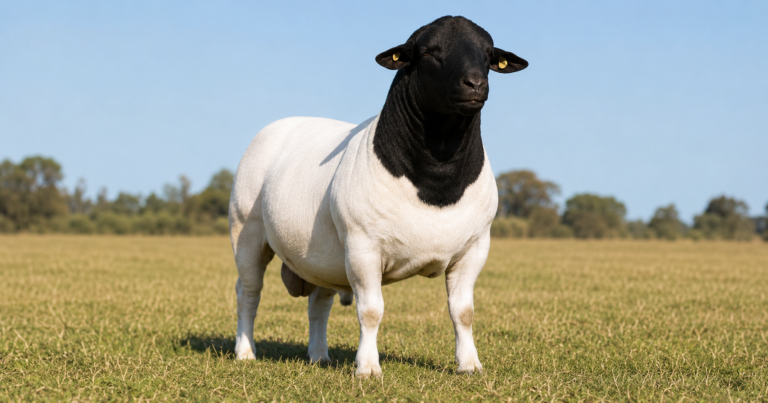
Obvious breed characteristics to verify include the distinctive black head and neck of the Blackhead Dorper, the characteristic wide and well-muscled body conformation, and the absence of a heavy staple fleece. A trained eye, or guidance from a knowledgeable livestock consultant, is worth the effort before committing to a significant purchase.
Conclusion
Dorper sheep are expensive because the factors that make them expensive are real — not manufactured. Structured stud genetics, performance testing programmes, importation and quarantine costs, limited supply against growing regional demand, and documented commercial performance traits all contribute to a price that, while high compared to local breeds, reflects genuine underlying value.
For farmers running commercial meat enterprises or grading-up programmes in East Africa, the question is less why are Dorper sheep expensive and more what return can I generate per rand or shilling invested in quality genetics? On a well-managed operation, that return is consistently positive — which is ultimately the reason the market supports these prices in the first place.