

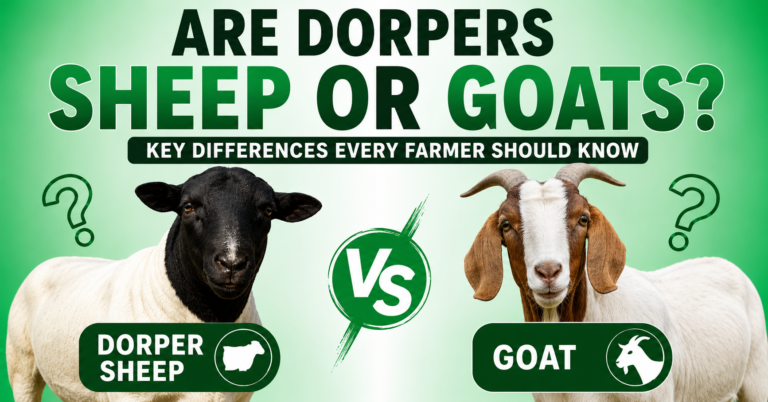
Many beginner livestock farmers ask the same question: are Dorpers sheep or goats? The confusion is understandable because Dorper sheep look different from traditional wool breeds. Their short hair coat, muscular build, and hardy nature often make people mistake them for goats, especially in mixed farming systems.
However, Dorpers are sheep, not goats. They are a specialized meat sheep breed originally developed in South Africa for efficient lamb production under harsh grazing conditions. Understanding the difference helps farmers manage feeding, breeding, fencing, and health programs correctly.
Are Dorpers Sheep or Goats?
Dorper animals are sheep. The breed was developed by crossing Dorset Horn sheep with Blackhead Persian sheep to create a hardy meat-producing sheep suited to dry environments. Unlike goats, Dorpers are classified as hair sheep because they shed much of their coat naturally instead of producing heavy wool.
In practical farm settings, Dorpers behave more like traditional sheep than goats. They prefer grazing pasture and forbs, while goats naturally browse shrubs and woody plants more aggressively.
Why People Confuse Dorper Sheep With Goats
Dorper sheep are commonly mistaken for goats because they have short hair instead of dense wool. Their upright posture, alert ears, and active grazing style can resemble certain meat goat breeds. Young Dorper lambs especially confuse inexperienced farmers at livestock markets.
Another reason is adaptability. Dorpers survive well in dry areas where goats are also popular. On commercial farms, both species may share grazing systems, increasing the confusion for new livestock keepers.
Physical Differences Between Dorper Sheep and Goats
One major difference is tail position. Sheep tails usually hang downward, while goat tails often point upward. Dorper sheep also have a stockier body with heavier muscling through the loin and hindquarters, which is important for meat production.
Dorper rams generally have a broader chest and thicker frame than goats of similar size. In addition, sheep typically graze closer to the ground, while goats prefer browsing leaves, bushes, and higher vegetation.
Feeding and Grazing Behavior
Dorper sheep are efficient grazers and perform well on pasture-based systems. They consume grasses, legumes, and crop residues effectively when managed correctly. While they can browse occasionally, they are not as aggressive as goats when feeding on shrubs or trees.
Farmers raising Dorpers commercially often use rotational grazing to maintain pasture quality and reduce parasite pressure. Proper mineral supplementation is also important because nutritional deficiencies can affect lamb growth and fertility.
Meat Production Differences
Dorper sheep are highly regarded in the sheep meat industry because of their rapid growth, good carcass shape, and efficient feed conversion. They are specifically bred for lamb production rather than milk or fiber.
Compared to goats, Dorper lamb meat usually has a milder flavor and higher carcass yield. However, meat quality depends heavily on nutrition, genetics, slaughter age, and overall flock management.
Temperament and Farm Management
Dorper sheep are generally calm and manageable under good handling systems. They adapt well to extensive grazing operations and semi-intensive meat production systems. Goats, on the other hand, are usually more curious, agile, and likely to challenge fencing.
From practical experience, Dorper sheep require strong parasite management, especially in humid climates. Farmers also need proper lambing supervision during difficult weather conditions to reduce losses in young lambs.
Conclusion
So, are Dorpers sheep or goats? Dorpers are definitely sheep, specifically a highly productive meat sheep breed developed for harsh grazing conditions. Although their appearance sometimes resembles goats, their genetics, feeding behavior, and production systems clearly place them in the sheep category.
For practical farmers, understanding these differences helps improve feeding strategies, pasture management, breeding decisions, and overall flock performance. Like any livestock enterprise, Dorper production success depends on good genetics, nutrition, health management, and adapting systems to local conditions.