

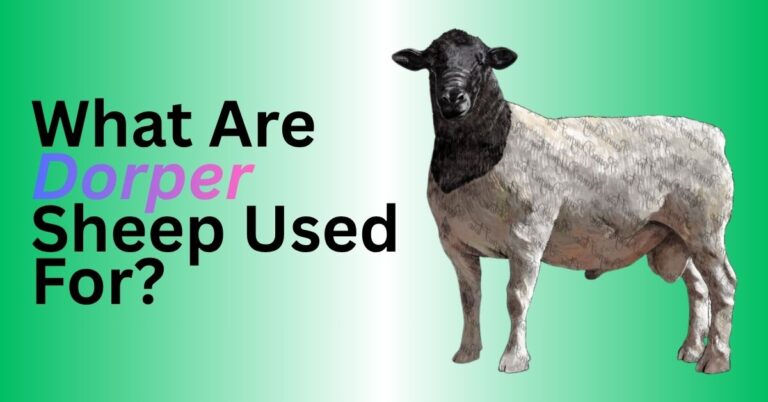
If you’ve spent any time researching meat sheep breeds, you’ve probably come across the Dorper. Walk into a sheep operation in Texas, Oklahoma, or the Southwest and there’s a good chance you’ll find a pen full of these stocky, white-bodied animals with their distinctive black heads. That’s no coincidence. Dorper sheep are purpose-built for one thing above all else: efficient, high-quality meat production — and they’re remarkably good at it.
So what are Dorper sheep used for, exactly? The short answer is meat. But the longer answer involves a breed that has earned its reputation through exceptional adaptability, low-input management requirements, and reproductive efficiency that few other breeds can match. Whether you’re running a commercial lamb operation or managing a small farm, understanding what Dorpers are bred and raised for will help you decide if they belong in your program.
The Primary Purpose: Dorper Sheep Are a Meat Breed
Let’s be direct — Dorper sheep are a dedicated meat breed. They were developed in South Africa during the 1930s and 1940s by crossing Dorset Horn rams with Blackhead Persian ewes. The goal was simple: create a breed capable of producing good carcass quality under harsh, semi-arid conditions where other breeds struggled to survive, let alone perform.
That original purpose hasn’t changed. When farmers ask what Dorper sheep are bred for, the answer is consistent across continents: terminal meat production. The breed produces a well-muscled, medium-to-heavy carcass with a good fat cover and mild-flavored meat that suits a broad consumer market. Carcass dressing percentages typically fall in the 48–52% range under reasonable conditions, which is competitive for a hair sheep.
What sets Dorpers apart from other meat breeds is the combination of carcass quality and adaptability. You’re not just getting a sheep that finishes well on high-quality pasture. You’re getting one that can still put on muscle on marginal rangeland — a trait that directly impacts your bottom line.
Are Dorper Sheep Good for Meat? What Farmers Actually See
Are Dorper sheep good for meat? The answer is yes — and that assessment holds up across a wide range of production systems. The breed’s meat has a relatively mild flavor compared to some other sheep breeds, which makes it more appealing to mainstream consumers who may not be accustomed to stronger mutton flavors. Lambs finished on pasture or supplemented with grain typically reach market weight of 100–130 pounds by 5 to 7 months of age, though this varies significantly depending on management, nutrition, and genetics.
In commercial operations, Dorper lambs are often run as straightbreds or used in crossbreeding programs where the Dorper or White Dorper serves as the terminal sire. When crossed with Rambouillet or Merino ewes, the resulting lambs show strong hybrid vigor and solid growth rates. Many producers report average daily gains of 0.5 to 0.8 pounds per day under adequate nutritional conditions — good performance for a range-adapted breed.
One thing worth noting: genetics within the Dorper breed vary considerably. Not all Dorpers are created equal. Working with seedstock producers who track EPDs (Expected Progeny Differences) and performance records will give you a meaningful advantage over sourcing animals purely on appearance or price.
What Are Dorper Sheep Known For? Hardiness and Low Maintenance
Beyond meat production, Dorper sheep are widely known for their exceptional hardiness and relatively low maintenance requirements. This is arguably the trait that has driven their rapid adoption across North America, particularly in regions with hot summers, unpredictable rainfall, and sparse forage conditions.
Unlike wool breeds, Dorpers shed their fleece naturally. This single characteristic eliminates shearing costs, reduces labor demands, and removes one of the more time-intensive management tasks in a traditional sheep operation. Shearing a flock of 200 ewes might cost several hundred dollars and take a full day of coordinated effort. With Dorpers, that task disappears from your calendar entirely.
The breed also demonstrates solid resistance to internal parasites compared to fine-wool breeds, though this doesn’t mean parasite management can be ignored. FAMACHA scoring, strategic deworming based on fecal egg counts, and pasture rotation remain critical components of a sound health program. Dorpers are more tolerant, not immune. Producers who abandon structured parasite management protocols often learn this the hard way.
Heat tolerance is another well-documented trait. Dorpers handle hot, humid summers better than many traditional British meat breeds, making them well-suited to the American South and Southwest.
What Are Dorper Sheep Used For in the U.S.?
In the United States, Dorper sheep are used primarily in commercial lamb and meat goat country — particularly across Texas, the southern plains, and arid western states. They’ve also made significant inroads in the Southeast and Mid-Atlantic regions, where producers are transitioning away from wool-focused breeds toward lower-maintenance, meat-oriented systems.
The USDA and American Sheep Industry data consistently show Dorpers and White Dorpers among the fastest-growing registered sheep breeds in the country over the past two decades. Their use in the U.S. breaks down into a few distinct categories:
Commercial Meat Production: Producers use Dorpers as a straightbred commercial flock or as terminal sires on range ewes. The goal is efficient, low-cost lamb production for direct-to-consumer, auction, or ethnic market channels.
Seedstock and Registered Operations: A growing segment of producers breed registered Dorpers and White Dorpers, selling quality rams and ewes to commercial producers looking to improve their flocks. This segment has grown substantially as demand for performance-tested animals increases.
Ethnic Market Supply: Demand from ethnic communities — particularly those with Middle Eastern, African, and Hispanic cultural backgrounds — has created a strong market for fresh, whole carcass and live sheep. Dorpers fit well into this niche because of their carcass quality and consistent availability.
Pasture-Based Small Farm Operations: Many small-acreage farmers use Dorpers because of their self-sufficient nature, ease of management, and ability to thrive on grass with minimal grain supplementation.
Are Dorper Sheep Dual Purpose? Understanding Wool vs. Meat
A common question is whether Dorper sheep are dual purpose — meaning useful for both meat and wool. The straightforward answer is no. Dorpers are not a dual-purpose breed in any meaningful commercial sense.
While Dorpers do produce a mixed fleece of hair and wool fibers, the fleece is neither consistent enough nor fine enough to be commercially marketable as wool. The natural shedding cycle further disrupts any possibility of clean shearing. If your operation depends on wool income, the Dorper is not your breed.
This stands in contrast to breeds like the Rambouillet, Merino, or Corriedale, which balance usable wool production with reasonable meat yields. Those breeds serve producers who want income from both fiber and carcass. The Dorper makes a different trade-off — it sacrifices wool utility entirely in exchange for hardiness, heat tolerance, meat quality, and self-shedding convenience.
Some producers ask whether Dorpers can produce milk for cheese or lamb-raising purposes. While Dorper ewes are adequate milkers for raising their own lambs — and ewes with strong mothering instincts will reliably raise twins — they are not dairy-grade producers. Milking Dorpers commercially for cheese or dairy products is not a practical production model.
Conclusion: What Are Dorper Sheep Used For — And Are They Right for You?
What are Dorper sheep used for? Meat production — full stop. Everything else about the breed, from their self-shedding coat to their heat tolerance to their broad-season cycling, exists in service of that single purpose. They were built to convert marginal forage into marketable lamb with less labor and lower overhead than most breeds demand, and they deliver on that promise in a wide range of climates and production systems.
They won’t generate wool income. They won’t win any dairy records. But for producers focused on efficient, low-maintenance lamb production — whether you’re running 20 ewes on a small farm or 500 on open range — the Dorper offers a practical combination of traits that’s hard to find in a single breed.
That said, no breed compensates for poor management. The producers who get the most out of Dorpers are the ones who take nutrition, parasite control, and genetics seriously. Source animals from breeders who track performance data, visit operations in your region before you commit, and build your health program before your first lambs hit the ground. Do those things, and the Dorper will hold up its end of the deal.