

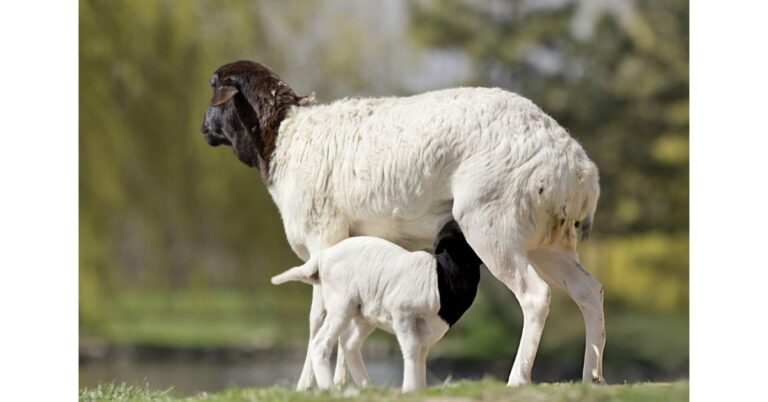
If you’ve been asking whether Dorper sheep are good mothers, you’re not alone — it’s one of the most practical questions a producer can ask before committing to the breed or expanding an existing flock.
Lambing percentage means nothing if ewes won’t raise their lambs. A ewe that produces twins but abandons one at birth, or a first-lamber that walks away from her newborn within the first hour, costs you more than a missed conception — she costs you the entire season’s investment in that pregnancy.
The breed’s reputation for hardiness, fast growth, and adaptability is well established. But mothering ability is a production trait that doesn’t always get the attention it deserves in breed promotion material, and it’s the kind of thing that matters enormously once you’re walking paddocks at first light checking on newly born lambs.
The practical answer is that Dorpers are generally regarded as good mothers within the context of a well-managed production system — but like every aspect of sheep production, the detail is in the management, the nutrition, the lambing environment, and the individual animals you’re working with.
Are Dorper Sheep Good Mothers?
Yes, Dorper sheep are considered good mothers by commercial meat sheep standards, particularly when managed under appropriate conditions. The breed was developed in South Africa specifically for adaptability and productivity in semi-arid rangeland environments, and that background selected for ewes capable of raising lambs with minimal human intervention.
In practical terms, this translates to ewes that generally bond quickly with their lambs, show strong interest in cleaning and stimulating newborns, and get their lambs onto the teat within a reasonable timeframe after birth. Colostrum intake in the first few hours of life is critical for lamb survival and passive immunity transfer, and ewes that bond well and stand for suckling give their lambs the best possible start.
That said, no breed produces 100% perfect mothers, and Dorpers are no exception. First-time ewes, ewe lambs joining the breeding flock at a young age, and ewes that were poorly nourished through late pregnancy can all display suboptimal maternal behavior. The breed’s general capacity for good mothering sets a solid baseline — but individual variation and management quality determine the outcomes you see on the ground.
Do Dorper Sheep Have Good Mothering Ability?
Mothering ability in sheep is influenced by both genetics and environment, and Dorpers score reasonably well on both fronts. From a genetic standpoint, the breed’s selection history in extensive rangeland conditions meant that ewes with poor maternal instincts simply raised fewer lambs, creating natural selection pressure toward competent mothering over generations.
In managed production systems, Dorper ewes typically display the behavioral markers associated with good mothering ability: attentive licking behavior immediately after birth, low-pitched vocalizations to maintain contact with the lamb, positioning to allow the lamb to suckle, and aggressive defense of the lamb against perceived threats — including from handlers.
Litter size affects mothering performance in any breed. A ewe raising a single lamb has a considerably easier task than one raising triplets on a pasture-based system without supplementary feeding. Dorpers used in intensive crossbreeding programs where higher litter sizes are encouraged will require nutritional support and closer management at lambing to achieve strong weaning outcomes.
Where Dorpers genuinely stand out is in their ability to maintain condition and milk production under difficult seasonal conditions. A ewe that holds her body condition through a dry spring is better equipped to milk well and maintain strong maternal behavior than one that has been nutritionally depleted. This resilience is a real-world advantage in variable climates.
Do Dorper Ewes Reject Lambs?
Lamb rejection does occur in Dorper ewes, as it does in all sheep breeds — the question is frequency and context. Under well-managed conditions, outright rejection in Dorpers is not common, but there are specific circumstances that elevate the risk considerably.
First-lambing ewe lambs are the most common source of rejection problems. A ewe lamb that was joined early, carried a lamb at a young age, and lambs in a crowded or high-pressure environment may not display the same maternal confidence as a mature ewe in her second or third lambing. She may be confused by the birthing process, slow to bond, or easily disturbed by other ewes moving nearby. This is not a breed fault — it’s a predictable response to asking an immature animal to perform a complex maternal task.
Twins and triplets present additional rejection risk. A ewe that lambs quickly with a single may bond tightly and walk away before fully processing the second lamb. Particularly in open paddock lambing, the second or third lamb can be left behind as the ewe moves off with the first. Close monitoring of multiple-bearing ewes in the final stages of pregnancy and the immediate post-lambing period reduces lamb losses significantly.
Disturbed lambing environments also elevate rejection risk. Ewes that are moved, mustered, or heavily disturbed immediately post-lambing may abandon lambs. Allowing ewes space and quiet in the hours after birth is one of the simplest management interventions available to reduce rejection.
When rejection does occur, early intervention matters. A ewe that has not fully rejected her lamb — one that is simply slow to bond rather than actively hostile — can often be assisted through restraint in a small pen with her lamb, with human-assisted suckling to ensure the lamb receives colostrum. Full rejection is harder to reverse and typically requires either a foster ewe or artificial rearing.
Do Dorper Ewes Have Strong Maternal Instincts?
Dorper ewes show strong maternal instincts by commercial meat breed standards, and this trait is one of the practical reasons the breed has been adopted so widely in extensive production systems where individual lamb supervision isn’t always feasible.
The instinct to protect lambs from perceived predators is notably present in Dorper ewes. In areas where foxes, wild dogs, or other predators are active, a ewe that stands her ground and stamps, vocalizes, and positions herself between the threat and her lamb gives that lamb a meaningfully better chance of survival than a ewe that simply flees. Producers running Dorpers in areas with predator pressure often comment on this behavior as a practical breed advantage worth preserving in selection decisions.
Maternal recognition — the ability of a ewe to identify and preferentially respond to her own lamb through olfactory, auditory, and visual cues — is well developed in Dorpers. This matters at marking time, when mixing of mobs can temporarily separate ewes and lambs. A ewe with strong maternal recognition will locate and reunite with her lamb more reliably than one with weaker bonding.
However, maternal instinct is not a fixed quantity. It is influenced by age and parity, nutrition through late pregnancy, lambing environment, flock density at lambing, and the genetics of the individual animal. Ewes that have successfully raised lambs in previous seasons typically show stronger, more confident maternal behavior than first-timers. Selecting replacement ewes from mothers that demonstrated excellent maternal performance is a straightforward way to progressively improve this trait across your flock.
When Maternal Instincts Need Support
Even well-bred Dorper ewes sometimes need assistance. Key situations that call for closer supervision include ewes in the final week of pregnancy carrying multiple lambs — these should be monitored daily, ideally twice daily in intensive systems, and shifted to a well-grassed lambing paddock close to yards.
A ewe in good body condition score, targeting a BCS of 3 to 3.5 at lambing, is better equipped hormonally and nutritionally to express strong maternal behavior. Cold, wet conditions at lambing substantially increase the risk of lamb hypothermia and mismothering. Even a ewe with excellent maternal instincts may struggle to keep lambs warm and stimulated enough to stand and suckle in challenging weather. A lambing shelter — whether a purpose-built shed or a well-positioned natural windbreak — can be the difference between lambs surviving the first twelve hours and those that don’t.
Practical Management for Strong Mothering Outcomes
Getting the best from Dorper ewes at lambing comes down to pre-lambing preparation and attentive management during the lambing period itself.
Nutrition is foundational. Ewes that enter late pregnancy in poor body condition have elevated cortisol, compromised colostrum quality, and reduced milk production. Supplementary feeding with quality hay or a grain-based ration in the final six weeks of pregnancy — commonly referred to as steaming up — supports fetal development and prepares the ewe hormonally and physically for lambing and lactation. Under-nourished ewes produce less colostrum, and inadequate colostrum transfer is one of the leading contributors to neonatal lamb losses.
Lambing paddock selection matters. A well-grassed paddock with natural shelter, close enough to yards for easy observation but large enough to allow ewes to find a quiet lambing spot, provides the conditions that support natural maternal behavior. Avoid lambing in heavily pugged, wet, or exposed paddocks where possible.
Reduce unnecessary disturbance. The 24 to 48 hours post-lambing are critical for bonding. Avoid unnecessary mustering, dog work, or paddock entries during this window unless lamb survival is at immediate risk.
Tag and record early. Ear tagging within the first 24 to 48 hours of birth, combined with recording dam and lamb identification, gives you the data to identify ewes with consistent mothering problems across multiple seasons. Pattern recognition over two or three lambings is more informative than any single observation, and it gives you an objective basis for culling decisions.
Conclusion
Dorper sheep are genuinely good mothers by commercial meat breed standards, with strong bonding behavior, reliable milk production under rangeland conditions, and a protective instinct that serves them well in extensive systems. For producers who have been asking whether Dorper sheep are good mothers before making a breed decision, the evidence from commercial operations consistently supports the breed’s maternal reputation — provided the right management foundations are in place.
That said, good mothering ability is not automatic. It requires sound nutritional management through pregnancy, an appropriate lambing environment, attentive observation during the lambing period, and a breeding program that actively selects for maternal performance alongside growth and carcase traits. First-time ewe lambs, multiple-bearing ewes, and animals under nutritional stress all carry elevated risk of mismothering or rejection and deserve closer attention.
For producers looking to improve lambing outcomes in an existing Dorper flock, the investment in pre-lambing nutrition, lambing paddock management, and early intervention protocols will return more value than almost any other input. The breed has the maternal capacity — your job as a manager is to create the conditions where that capacity can express itself fully.