

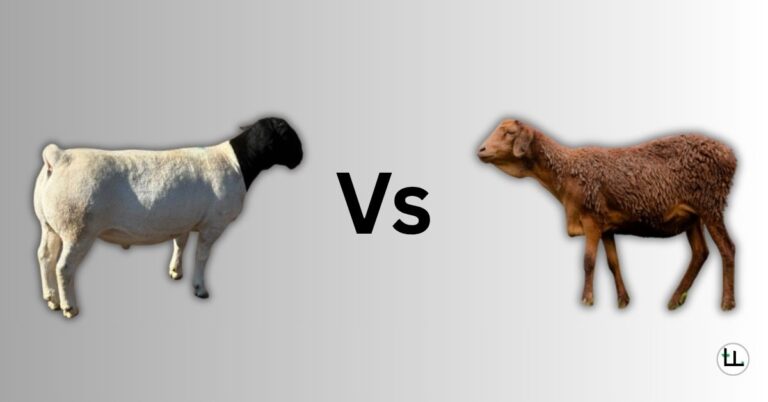
Dorper vs Red Maasai sheep is a common comparison among livestock farmers in Kenya and other East African countries looking to improve flock productivity and profitability. Both breeds have earned strong reputations, but they were developed for different production environments and management systems. Dorper sheep are internationally recognized for their rapid growth performance, excellent feed conversion, and superior meat production, while Red Maasai sheep are valued for their exceptional adaptation to harsh environments, natural disease resistance, and ability to survive under low-input grazing systems.
Choosing between the two breeds depends on production goals, pasture availability, climate, disease pressure, management capacity, and market demand. Some farmers raise purebred flocks, while others use crossbreeding programmes to combine the rapid growth of Dorper sheep with the hardiness and parasite resistance of Red Maasai sheep.
This guide compares Dorper and Red Maasai sheep in terms of origin, physical characteristics, growth rate, fertility, adaptability, feed efficiency, disease resistance, meat production, and profitability to help farmers select the breed that best suits their farming objectives.
Table of Contents
Overview of Dorper Sheep
Dorper sheep originated in South Africa through the crossing of the Dorset Horn and the Blackhead Persian.
The breed was specifically developed to produce high-quality meat under a wide range of environmental conditions while maintaining rapid growth and efficient feed utilization.
Today, Dorper sheep are raised in many countries because of their:
- Excellent growth performance
- Efficient feed conversion
- High carcass yield
- Fast maturity
- Good fertility
- Adaptability
- Strong mothering ability
Their ability to perform under both intensive and extensive production systems has made them one of the world’s most popular meat sheep breeds.
Overview of Red Maasai Sheep
The Red Maasai is an indigenous East African sheep breed that has been raised by pastoral communities for generations.
The breed evolved under challenging grazing conditions where survival, disease resistance, and adaptability were more important than rapid growth.
Red Maasai sheep are well known for their:
- Excellent adaptation to harsh climates
- Strong resistance to internal parasites
- Ability to utilize poor-quality forage
- Good mothering ability
- High survival under extensive grazing
These characteristics make the breed particularly valuable in low-input production systems.
Origin and Breed Development
Although both breeds are highly adaptable, their breeding objectives were very different.
Dorper sheep were developed primarily to maximize meat production and growth efficiency.
Red Maasai sheep evolved naturally through generations of adaptation to East African pastoral systems.
As a result:
- Dorper emphasizes production.
- Red Maasai emphasizes survival.
These contrasting breeding histories explain many of the differences seen between the two breeds today.
Physical Characteristics
Dorper sheep and Red Maasai sheep are easy to distinguish.
Dorper Sheep
Dorper sheep typically have:
- Large muscular bodies.
- Broad chest.
- Thick hindquarters.
- Short hair and wool coat.
- White body with a black head (Black-headed Dorper) or completely white coat (White Dorper).
Their body structure is designed for maximum meat production.
Red Maasai Sheep
Red Maasai sheep generally have:
- Medium body size.
- Characteristic reddish-brown coat.
- Fat tail.
- Leaner body conformation.
- Strong legs suitable for long-distance walking.
Their body design reflects adaptation to extensive grazing and harsh environments.
Growth Rate Comparison
One of the biggest differences between the breeds is growth rate.
Dorper lambs grow rapidly when provided with balanced nutrition.
Their excellent growth performance allows producers to market lambs at younger ages while reducing finishing time.
Red Maasai lambs generally grow more slowly because the breed evolved for survival rather than maximum growth.
However, they maintain relatively consistent growth under conditions where improved breeds may struggle.
Farmers focusing primarily on commercial meat production usually prefer Dorper sheep because of their superior growth potential.
Feed Conversion Ratio
Dorper sheep are widely recognized for excellent feed conversion.
They efficiently convert balanced diets into lean muscle, making them highly profitable under commercial production systems.
Red Maasai sheep are highly efficient at utilizing poor-quality forage, although they generally produce slower weight gains than Dorper sheep.
This means:
- Dorper converts quality feed into meat very efficiently.
- Red Maasai survives efficiently on limited feed resources.
The better choice depends on available feeding resources and production objectives.
Adaptability to Different Environments
Both breeds are highly adaptable, although they excel under different conditions.
Dorper sheep perform well under:
- Intensive production.
- Semi-intensive systems.
- Improved pasture.
- Supplementary feeding programmes.
Red Maasai sheep perform exceptionally well under:
- Extensive grazing.
- Low-input systems.
- Dry environments.
- Communal grazing areas.
- Challenging pastoral conditions.
Their natural hardiness allows them to remain productive where improved breeds may experience greater stress.
Disease Resistance
Disease resistance is one of the most important differences between Dorper and Red Maasai sheep.
Dorper Sheep
Dorper sheep are generally healthy and hardy when managed properly.
Maintaining good flock health requires:
- Routine vaccination programmes
- Strategic internal parasite control
- Balanced nutrition
- Proper biosecurity
- Clean housing
Under good management, Dorper sheep perform exceptionally well and achieve excellent production results.
Red Maasai Sheep
Red Maasai sheep are internationally recognized for their natural resistance to internal parasites, particularly gastrointestinal worms.
This genetic resistance helps reduce:
- Parasite burdens.
- Production losses.
- Mortality.
- Dependence on deworming treatments.
Although Red Maasai sheep are not completely immune to parasites, they often perform better than many exotic breeds under high parasite pressure.
Fertility and Reproduction
Both breeds demonstrate good reproductive performance, although there are notable differences.
Dorper Sheep
Dorper ewes are known for:
- High fertility.
- Strong mothering ability.
- Good milk production.
- Rapid lamb growth.
- Excellent lamb survival under good management.
Their ability to lamb regularly contributes to high flock productivity.
Red Maasai Sheep
Red Maasai ewes are also excellent mothers.
Their strengths include:
- High lamb survival.
- Strong maternal instincts.
- Adaptation to extensive systems.
- Good reproductive efficiency under harsh conditions.
While lamb growth is generally slower than Dorper sheep, survival rates can remain high under difficult environmental conditions.
Meat Production
Meat production is where Dorper sheep have a clear advantage.
Dorper Sheep
Dorper sheep were specifically developed as a meat breed.
They produce:
- Heavy carcasses.
- Excellent muscle development.
- High dressing percentage.
- Lean, tender meat.
- Rapid finishing.
Commercial meat producers often favor Dorper sheep because they reach market weight more quickly.
Red Maasai Sheep
Red Maasai sheep also produce quality meat but generally have:
- Smaller carcasses.
- Slower finishing rates.
- Lower muscle mass.
- Reduced growth rates.
However, they remain valuable in traditional production systems where adaptation and survival outweigh maximum meat yield.
Feed Requirements
Nutritional requirements differ between the two breeds because of their production potential.
Dorper Sheep
Dorper sheep perform best when provided with:
- High-quality forage
- Adequate energy
- Balanced protein
- Continuous mineral supplementation
- Clean drinking water
Improved nutrition allows the breed to express its superior growth performance and feed conversion.
Red Maasai Sheep
Red Maasai sheep are more capable of utilizing:
- Poor-quality pasture.
- Natural grazing.
- Sparse vegetation.
- Seasonal forage shortages.
Although supplementation improves productivity, the breed can survive and reproduce under feeding conditions that would significantly reduce the performance of many improved breeds.
Housing Requirements
Both breeds benefit from clean, well-ventilated housing, but their management systems often differ.
Dorper sheep raised under commercial production systems commonly receive:
- Improved housing.
- Controlled feeding.
- Regular health monitoring.
- Performance recording.
Red Maasai sheep are frequently managed under extensive grazing systems where housing mainly provides:
- Night shelter.
- Predator protection.
- Lambing facilities.
- Protection during severe weather.
Regardless of breed, clean housing supports good health and productivity.
Adaptation to Kenya
Both breeds are well suited to Kenyan conditions, but each has different strengths.
Dorper Sheep in Kenya
Dorper sheep perform particularly well in:
- Commercial meat enterprises.
- Semi-intensive farms.
- Improved pasture systems.
- Farms using supplementary feeding.
Their rapid growth makes them attractive to farmers targeting premium meat markets.
Red Maasai Sheep in Kenya
Red Maasai sheep excel in:
- Pastoral systems.
- Arid and semi-arid lands (ASALs).
- Low-input production.
- Areas with heavy parasite challenges.
Their exceptional hardiness makes them one of Kenya’s most valuable indigenous sheep breeds.
Crossbreeding Dorper and Red Maasai Sheep
Many Kenyan farmers successfully cross Dorper rams with Red Maasai ewes.
The objective is to combine:
- Dorper’s excellent growth performance.
- Dorper’s superior feed conversion.
- Red Maasai’s parasite resistance.
- Red Maasai’s environmental adaptation.
- Red Maasai’s hardiness.
A well-managed crossbreeding programme may produce lambs that outperform either parent breed under local production conditions.
Crossbreeding should be carefully planned to preserve desirable genetic traits while avoiding indiscriminate breeding.
Common Mistakes When Choosing Between the Two Breeds
Farmers sometimes select breeds based solely on popularity rather than production goals.
Common mistakes include:
- Choosing Dorper sheep without adequate feed resources.
- Ignoring parasite pressure.
- Overlooking pasture quality.
- Failing to match breed choice with climate.
- Neglecting mineral supplementation.
- Ignoring breeding objectives.
- Purchasing poor-quality breeding stock.
- Failing to implement effective health programmes.
Selecting the right breed begins with evaluating farm resources and long-term business goals.
Frequently Asked Questions
Which breed grows faster, Dorper or Red Maasai?
Dorper sheep generally grow much faster and achieve heavier market weights because they were specifically developed for meat production.
Which breed has better parasite resistance?
Red Maasai sheep are widely recognized for their superior natural resistance to internal parasites, particularly gastrointestinal worms.
Which breed produces more meat?
Dorper sheep produce larger carcasses, better muscling, and higher meat yields than Red Maasai sheep.
Which breed is better for arid areas?
Red Maasai sheep are generally better adapted to harsh grazing conditions and prolonged feed shortages, although Dorper sheep also perform well under good management.
Can Dorper and Red Maasai sheep be crossbred?
Yes. Crossbreeding is common in Kenya to combine the fast growth of Dorper sheep with the hardiness and parasite resistance of Red Maasai sheep.
Which breed is more profitable?
Profitability depends on the production system. Dorper sheep often generate higher returns in commercial meat enterprises with good nutrition, while Red Maasai sheep may be more profitable in low-input systems because of their lower management requirements and greater resilience.
Conclusion
When comparing Dorper vs Red Maasai sheep, there is no universally superior breed because each excels under different production conditions. Dorper sheep are the preferred choice for commercial meat production due to their outstanding growth performance, efficient feed conversion, rapid maturity, and excellent carcass quality. They perform best where farmers can provide high-quality forage, balanced nutrition, effective health management, and good overall husbandry.
Red Maasai sheep, on the other hand, remain one of East Africa’s most valuable indigenous breeds because of their exceptional adaptation to harsh environments, natural resistance to internal parasites, and ability to thrive under low-input grazing systems. These qualities make them particularly well suited to pastoral and semi-arid production systems.
For many Kenyan farmers, crossbreeding Dorper and Red Maasai sheep offers the best of both worlds by combining improved meat production with greater hardiness and resilience. Ultimately, the most profitable choice depends on pasture availability, climate, disease pressure, management capacity, and long-term breeding objectives.