

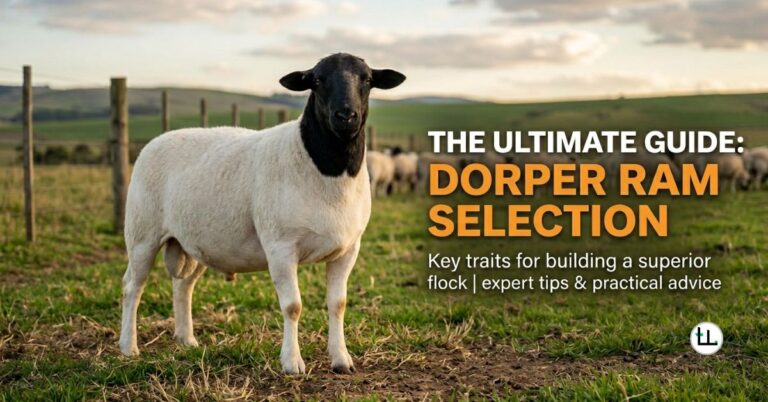
For any Dorper sheep enterprise, the ram contributes half of the genetic makeup of every lamb born. Consequently, selecting a breeding sire is one of the most important decisions affecting flock productivity and profitability.
While breeders often emphasize muscling, growth rate, shedding ability, and structural soundness, reproductive soundness is equally important. A superior-looking ram with poor fertility can significantly reduce conception rates and lower the number of lambs marketed each season.
Careful evaluation of the scrotum and testicles provides valuable insight into a ram’s reproductive capacity. Understanding normal and abnormal reproductive anatomy enables producers to avoid costly mistakes and maximize lambing percentages.
Table of Contents
Why Reproductive Soundness Matters in Dorper Sheep
Dorpers are renowned for their:
- Extended breeding season.
- High libido.
- Ability to breed out of season.
- Excellent adaptability to harsh environments.
- Rapid lamb growth.
These characteristics make them ideal for accelerated lambing systems. However, even exceptional genetics are wasted if a ram is unable to settle ewes efficiently.
A visual examination of the reproductive organs serves as an important screening tool before conducting a formal Breeding Soundness Examination (BSE). Early detection of abnormalities allows producers to identify subfertile or infertile rams before the breeding season begins.
Characteristics of an Ideal Dorper Ram Scrotum
A sound breeding ram should possess:
- Two evenly sized testicles.
- Symmetrical shape.
- Proper suspension.
- Smooth, healthy scrotal skin.
- Firm but elastic consistency.
- Adequate scrotal circumference.
- Absence of swelling or deformities.
When palpated, the testicles should feel similar to a flexed bicep—firm, resilient, and free of hard lumps or excessive softness.
Dorper Ram Scrotal Evaluation Guide
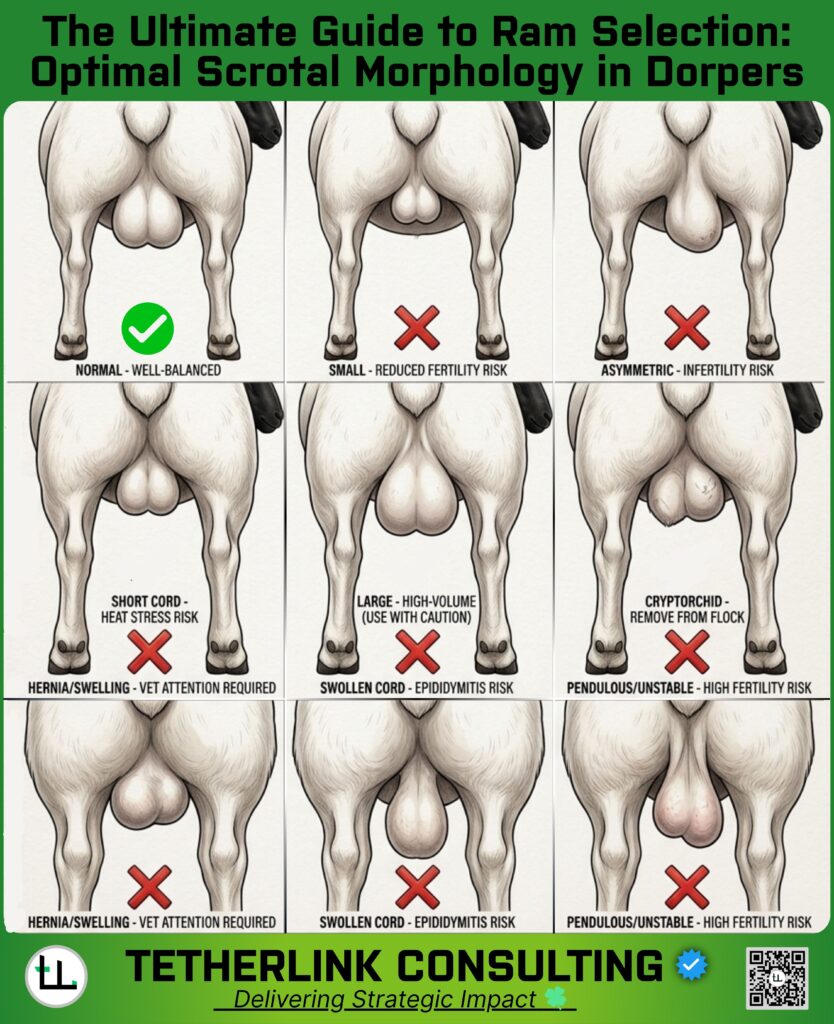
The following table summarizes common scrotal conformations and their implications for fertility.
| Scrotal Condition | Evaluation | Effect on Fertility | Recommendation |
| Normal, balanced | Excellent | High fertility potential | Preferred breeding sire |
| Large, well-developed | Acceptable | Usually associated with higher sperm production | Suitable for breeding |
| Short cord | Caution | Reduced cooling ability and heat stress risk | Further evaluation required |
| Small or atrophied | Poor | Low sperm production | Cull |
| Asymmetrical testicles | Poor | Possible injury or disease | Cull |
| Cryptorchid (undescended testicle) | Severe defect | Heritable infertility issue | Cull immediately |
| Localized swelling or hernia | Serious defect | May impair fertility and cause discomfort | Veterinary examination or cull |
| Swollen epididymal cord | Severe defect | Often associated with epididymitis or Brucella ovis infection | Cull immediately |
| Pendulous scrotum | Undesirable | Increased injury risk and impaired temperature regulation | Avoid for breeding |
| Hard lumps or fibrosis | Serious defect | Reduced sperm quality | Cull |
| Soft, spongy testicles | Poor | Testicular degeneration and low semen quality | Cull |
Major Reproductive Defects That Require Immediate Culling
Cryptorchidism
Cryptorchidism occurs when one or both testicles fail to descend into the scrotum. Because this defect is highly heritable, cryptorchid rams should never be retained for breeding.
Epididymitis
Inflammation and enlargement of the epididymis are frequently associated with Brucella ovis infection. Affected rams may become permanently infertile and can spread infection within the flock, resulting in reduced lambing percentages.
Testicular Atrophy
Shrunken or underdeveloped testicles generally indicate reduced sperm production. Rams exhibiting this condition seldom achieve satisfactory conception rates.
Excessively Pendulous Scrotum
Although moderate length is desirable, extremely low-hanging scrotums are susceptible to injury from thorns, brush, and rough terrain. Excessive pendulousness may also compromise the natural heat-exchange mechanism necessary for sperm production.
Importance of Testicular Temperature Regulation
Normal sperm production requires the testes to remain approximately 4 – 6°C below body temperature. The scrotum acts as a sophisticated cooling system that regulates this temperature.
Conditions that interfere with cooling include:
- Short spermatic cords.
- Excessive fat deposition.
- Fever.
- Heat stress.
- Scrotal inflammation.
- Injuries and abscesses.
Even temporary overheating may impair sperm quality for six to eight weeks, highlighting the importance of evaluating rams well before the breeding season.
Recommended Scrotal Circumference for Dorper Rams
Scrotal circumference is strongly associated with sperm output and the reproductive performance of female offspring.
| Age of Ram | Minimum Scrotal Circumference |
| 6 – 8 months | 28 – 30 cm |
| 9 – 12 months | 30 – 34 cm |
| 12 – 18 months | 34 – 36 cm |
| Mature rams (>18 months) | 36 – 40 cm |
Larger scrotal circumference generally correlates with:
- Increased sperm production.
- Higher serving capacity.
- Earlier puberty in daughters.
- Improved flock fertility.
Five-Step Field Examination Before Breeding
Ideally, evaluate all breeding rams 6 – 8 weeks before joining with ewes.
1. Check Symmetry
Stand directly behind the ram and confirm that both testicles are similar in size, shape, and position.
2. Palpate the Testicles
Healthy testicles should be firm and elastic. Avoid rams with:
- Soft or spongy tissue.
- Hard masses.
- Excessive fluid.
- Abnormal heat.
3. Confirm Complete Descent
Ensure that both testicles are fully descended and freely movable within the scrotum.
4. Examine the Epididymis
Inspect the head and tail of the epididymis for enlargement, swelling, or hard nodules that may indicate infection.
5. Inspect the Scrotal Skin
Look for:
- Tick damage.
- Abscesses.
- Scars.
- Wounds.
- Dermatitis.
These conditions can negatively affect sperm production and breeding performance.
Breeding Soundness Examination Is Still Essential
Although visual assessment is extremely valuable, it should not replace a complete Breeding Soundness Examination (BSE) performed by a veterinarian.
A BSE evaluates:
- Physical soundness.
- Testicular size.
- Semen motility.
- Sperm morphology.
- Reproductive health.
Conducting annual breeding soundness examinations helps ensure that only fertile, productive sires remain in the flock.
Conclusion
A Dorper ram represents one of the most valuable genetic investments in a sheep enterprise. Superior muscling and outstanding pedigree are meaningless if fertility is compromised. By carefully assessing scrotal conformation, testicular symmetry, epididymal health, and overall reproductive soundness, producers can eliminate subfertile sires before they affect flock performance.
Combining visual evaluation with a professional breeding soundness examination enables Dorper breeders to maximize conception rates, tighten lambing seasons, and protect the long-term genetic progress and profitability of their flock.