

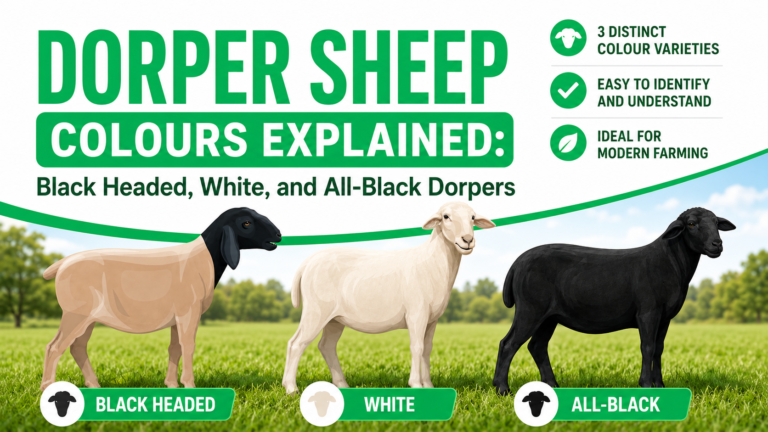
Dorper sheep are widely recognized for their fast growth, hardiness, and excellent carcass quality, but one of the first things farmers notice is their distinctive colour patterns. While many people associate Dorpers with a black head and white body, the breed actually comes in several accepted colour variations depending on genetics and breeding history.
Understanding Dorper sheep colour is important for both commercial and stud breeders. Colour can influence breed registration, buyer preference, show standards, and breeding decisions. In practical farming systems, however, performance traits such as growth rate, mothering ability, adaptability, and feed efficiency matter far more than appearance alone.
For farmers buying breeding stock, it is also important to understand how colour inheritance works so unexpected lamb colours do not cause confusion during lambing season.
Table of Contents
What Colors Do Dorper Sheep Come In?
Dorper sheep are mainly found in two recognized colour varieties:
- Black headed Dorper
- White Dorper
The traditional Dorper has a white body with a solid black head and neck. This is the most common and commercially recognized type in many countries. White Dorpers, on the other hand, are completely white or cream-white with little to no dark pigmentation.
In some flocks, farmers may also see:
- Mostly black sheep
- Speckled markings
- Dark patches on the body
- Completely black lambs
These colour variations usually result from recessive genetics or crossbreeding history somewhere in the bloodline.
Farmers often ask what color are Dorper lambs born. Lambs are generally born with the colour they will largely maintain into adulthood, although markings can become slightly lighter or darker with age. Black-headed lambs usually show clear pigmentation immediately after birth, while White Dorper lambs are born cream or white.
In extensive grazing systems, colour rarely affects production performance directly. However, stud breeders pay close attention to colour consistency because breed societies often have strict registration standards.
Black Headed Dorper vs All White Dorper
The discussion around Black Headed Dorper vs All White Dorper usually comes down to breeder preference, climate adaptability, and market demand rather than productivity differences alone.
The difference between white dorper and black headed dorper is primarily pigmentation. Black-headed Dorpers have dark pigmentation around the head and sometimes the neck, while White Dorpers lack this dark colouring almost entirely.
Many commercial farmers report very little difference in:
- Growth rate
- Fertility
- Carcass quality
- Feed conversion
- Mothering ability
However, there are some practical distinctions.
White Dorpers are sometimes preferred in extremely hot environments because lighter skin may absorb less heat. They are also favored in some export breeding programs where uniform white flocks are desired.
Black-headed Dorpers remain more common globally because they are the original and most recognizable type. In auction markets, buyers often identify them more quickly as “true Dorpers.”
Farmers also ask are white dorpers better than black headed dorpers. In reality, neither type is universally superior. Genetics, nutrition, parasite management, pasture quality, and flock management have a far greater impact on profitability than colour alone.
A poorly managed White Dorper flock will underperform compared to a well-managed black-headed flock and vice versa.
Why Do Dorper Sheep Have Black Heads?
Dorper sheep have black heads because of the breed’s original genetic development in South Africa during the 1930s.
The breed was developed by crossing:
- Dorset Horn sheep
- Blackhead Persian sheep
The Blackhead Persian contributed the distinctive dark pigmentation and exceptional hardiness traits. This pigmentation became one of the breed’s defining characteristics.
From a practical perspective, darker pigmentation around the head and eyes may offer some protection against:
- Intense sunlight
- Skin irritation
- Eye sensitivity in harsh grazing regions
Experienced sheep farmers in dry climates often notice that well-pigmented sheep handle strong sun exposure better than lightly pigmented animals, especially in open rangeland systems with minimal shade.
Over time, selective breeding stabilized the black-head trait in traditional Dorpers. Even today, breeders selecting replacement rams and ewes often prefer strong, clean head markings because they align with traditional breed standards.
That said, pigmentation patterns can vary slightly between bloodlines. Some sheep may have partially dark necks, light speckling, or faded markings without affecting overall production value.
Can Dorper Sheep Be All Black?
Yes, Dorper sheep can be all black, although this is less common in registered purebred flocks.
Completely black Dorpers usually appear because of recessive colour genetics inherited from previous generations. In some cases, black sheep may also result from crossbreeding with other meat sheep breeds carrying dominant dark pigmentation genes.
Commercial farmers occasionally see:
- Entirely black lambs
- Lambs with dark brown coats
- Black sheep with small white markings
This can surprise producers who expected only black-headed lambs from their breeding group.
In practical flock management, an all-black Dorper can still perform very well for:
- Meat production
- Fertility
- Grazing adaptability
- Maternal performance
However, breed societies may not always accept fully black sheep for registration depending on local breed standards.
For this reason, stud breeders usually monitor mating records carefully and select breeding animals with predictable colour patterns. Commercial meat producers are often less concerned about colour if the sheep maintain strong growth and carcass traits.
Dorper Sheep Color Genetics
Dorper sheep color genetics can sometimes appear unpredictable, especially in mixed breeding groups.
Colour inheritance in Dorpers involves dominant and recessive genes that control:
- Pigmentation
- Coat pattern
- Head colour
- Skin colour
A black-headed ram bred to white ewes can still produce:
- Black-headed lambs
- White lambs
- Spotted lambs
- Occasionally darker lambs
This happens because sheep may carry hidden recessive genes for several generations before they appear visibly in offspring.
Experienced breeders often keep detailed lambing and pedigree records to track colour inheritance patterns within the flock. This becomes especially important in stud operations aiming for registration consistency.
Environmental factors do not change the actual genetics of coat colour, but nutrition and health can influence coat appearance. Poor nutrition, mineral deficiencies, or heavy parasite burdens sometimes cause faded or rough-looking coats that farmers may mistake for genetic issues.
In well-managed Dorper systems, selection should prioritize:
- Structural correctness
- Fertility
- Lamb survival
- Growth efficiency
- Adaptability
Colour should remain secondary to production performance unless breeding specifically for stud or show markets.
Are All-Black Dorpers Purebred?
Not all all-black Dorpers are purebred, but some can be.
This is where many farmers become confused. An all-black sheep does not automatically mean crossbreeding has occurred. Some purebred Dorper bloodlines still carry recessive genes capable of producing darker offspring.
However, completely black sheep may raise questions during registration inspections because most breed standards emphasize either:
- Black head with white body
- Entirely white body
In commercial farming systems, purity is usually confirmed through:
- Registration papers
- Breeding records
- DNA verification where available
- Consistent breed characteristics
Experienced buyers evaluating breeding stock look beyond colour alone. They assess:
- Muscle development
- Body length
- Chest width
- Mothering ability
- Hoof quality
- Teeth alignment
- Overall adaptability
A sheep with ideal Dorper production traits may still be commercially valuable even if its colour falls outside strict show-ring preferences.
For farmers purchasing breeding rams, buying from reputable breeders with accurate flock records remains far more important than focusing only on coat colour.
what colors are accepted in dorper sheep
Accepted Dorper sheep colours depend partly on the breed society or registration authority operating in a specific country.
Generally, the recognized colour patterns include:
Black Headed Dorper
- White body
- Solid black head
- Some dark neck pigmentation accepted
White Dorper
- Entirely white or cream-white body
- Minimal dark pigmentation
Small spots or limited colour variation may sometimes be tolerated depending on local standards, but excessive black body colouring is often discouraged in formal stud registration programs.
Commercial producers usually place less emphasis on strict colour acceptance compared to stud breeders. In meat production systems, profitability depends more on:
- Lamb survival
- Daily weight gain
- Feed efficiency
- Carcass quality
- Parasite resistance
Still, maintaining colour consistency can improve marketability when selling breeding stock.
Farmers should also remember that colour alone does not guarantee genetic quality. A correctly coloured sheep with weak structure or poor fertility will still reduce flock productivity over time.
Conclusion
Dorper sheep colour is one of the breed’s most recognizable features, but it is only one part of what makes Dorpers valuable in commercial and breeding systems. Black-headed Dorpers and White Dorpers are both accepted varieties, while all-black sheep may occasionally appear because of recessive genetics or past breeding history.
For practical sheep farmers, performance should always come first. Fertility, growth rate, adaptability, mothering ability, and carcass quality will have a much bigger impact on flock profitability than coat colour alone.
Understanding Dorper sheep colour genetics helps farmers make better breeding decisions, avoid confusion during lambing, and maintain consistent flock standards over time.