

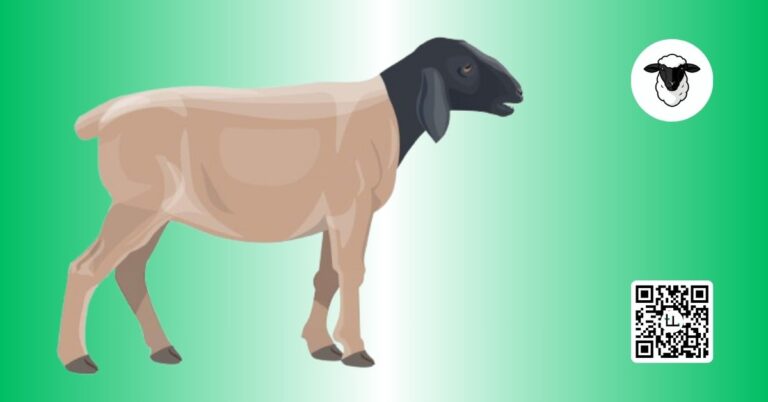
The Dorper sheep is a South African breed developed specifically for meat production in harsh, arid environments. It is widely regarded as one of the most efficient and profitable mutton breeds in the world, prized for its rapid growth, superior carcass quality, and extraordinary adaptability to extreme climates.
Unlike wool breeds that require annual shearing, the Dorper naturally sheds its fleece — a trait that dramatically reduces labor costs and makes it an attractive option for low-input farming systems. Today, Dorper sheep are farmed across Africa, Australia, the United States, the Middle East, and increasingly, East Africa — including Kenya and Uganda.
Origin and Breed History
The Dorper was developed in South Africa in the 1930s and 1940s by the Department of Agriculture. It was created by crossbreeding two established breeds:
- Dorset Horn — a British breed known for early maturity, out-of-season breeding, and good carcass conformation
- Blackhead Persian — an African breed renowned for extreme hardiness, drought resistance, and adaptability to tropical and semi-arid environments
The name “Dorper” is a portmanteau of Dorset Horn + Blackhead Persian. The Dorper Sheep Breeders’ Society of South Africa was established in 1950, formalizing breed standards and a studbook. From there the breed expanded globally — reaching Australia in the 1990s, the United States and Middle East in the 2000s, and now spreading rapidly across East Africa.
Physical Characteristics and Breed Standards
The Dorper is a medium- to large-framed sheep with a deep, wide, and well-muscled body. Key breed standard traits include a broad level back, full well-muscled hindquarters, strong legs with good hooves, and notably loose, pliable skin — a recognized indicator of feed conversion efficiency.
Weight Standards
| Category | Live Weight |
|---|---|
| Adult rams | 90–140 kg |
| Adult ewes | 55–90 kg |
| Lambs at weaning (90–100 days) | 28–32 kg |
| Lambs at slaughter (3–4 months) | 35–50 kg |
Coat and Self-Shedding
One of the Dorper’s most economically significant traits is its mixed coat of wool and hair that is naturally shed in late spring and early summer, triggered by changes in day length and temperature. Because of this, Dorpers do not require commercial shearing — saving farmers $5–$15 (KES 650–1,950) per animal per year. The shed fleece has no commercial wool value, which is by design: this breed was never intended as a dual-purpose animal.
The classic Dorper has a black head and neck with a white body. The line of demarcation between the two should be distinct and clean.
The White Dorper: A Distinct Variety
The White Dorper is an officially recognized variety of the breed — entirely white, with no black pigmentation. It was developed by selecting for the recessive allele for white coloration.
| Characteristic | Dorper | White Dorper |
|---|---|---|
| Head color | Black | White |
| Body color | White | White |
| Hide value | Lower (black skin on head) | Higher (uniform white hide) |
| Production performance | Identical | Identical |
In markets producing leather goods, the White Dorper’s uniform white hide commands a slight premium. In all other respects — growth rate, carcass quality, adaptability — the two varieties are equivalent.
Growth Rate and Carcass Quality
Average Daily Gain (ADG)
| System | ADG |
|---|---|
| Pre-weaning | 250–350 g/day |
| Post-weaning (pasture) | 150–250 g/day |
| Feedlot | 250–400 g/day |
Feed Conversion Ratio (FCR) under feedlot conditions is approximately 4.5:1 to 6:1 — competitive among all sheep breeds.
Carcass Characteristics
| Trait | Typical Value |
|---|---|
| Dressing percentage | 48–54% |
| Eye muscle area | 14–18 cm² |
| Fat depth (GR site) | 6–12 mm |
| Meat color | Pale pink to red |
| Fat color | White (superior to yellow fat) |
Dorper mutton is praised for tenderness, a mild flavor (low lanolin odor compared to Merino), even fat cover, and strong acceptance in halal markets worldwide.
Reproductive Performance
| Reproductive Trait | Typical Range |
|---|---|
| Age at first estrus | 5–7 months |
| Gestation period | 147–150 days |
| Lambing rate | 130–180% |
| Lamb survival to weaning | 85–95% |
| Inter-lambing interval | 240–270 days |
Crucially, Dorpers are year-round breeders — inherited from the Blackhead Persian, which evolved near the equator. This allows farmers to schedule three lambings in two years, significantly increasing lambs produced per ewe annually compared to seasonal breeds.
Adaptability and Hardiness
The Dorper’s adaptability is extraordinary:
- Heat tolerance: Can regulate body temperature in conditions exceeding 40°C
- Drought resilience: Maintains body condition on low-quality forage where wool breeds rapidly decline
- Browsing ability: Will graze grasses, browse shrubs, and utilize crop residues — critical in semi-arid East Africa
- Parasite resilience: Greater innate resistance to internal parasites than wool breeds; the absence of a dense fleece also eliminates blowfly strike risk — a major production loss in Merino farming
Dorper vs. Other Breeds: Technical Comparisons
Dorper vs. Merino
| Trait | Dorper | Merino |
|---|---|---|
| Primary purpose | Meat | Wool |
| Wool production | Negligible (self-shedding) | 4–8 kg greasy fleece/year |
| ADG (feedlot) | 250–400 g/day | 150–200 g/day |
| Dressing percentage | 48–54% | 42–48% |
| Breeding season | Year-round | Seasonal |
| Heat tolerance | Excellent | Moderate |
| Blowfly strike risk | Very low | Very high |
| Input requirements | Low–medium | Medium–high |
Verdict: In meat production systems, the Dorper decisively outperforms the Merino. When Merino ewes are crossed with Dorper rams (a common practice in Australia), the F1 lambs achieve markedly superior carcass quality.
Dorper vs. Boer Goat
| Trait | Dorper Sheep | Boer Goat |
|---|---|---|
| Mature male weight | 90–140 kg | 80–110 kg |
| ADG (feedlot) | 250–400 g/day | 150–250 g/day |
| Dressing percentage | 48–54% | 44–50% |
| Browsing ability | Good | Excellent |
| Parasite susceptibility | Moderate | Higher |
| East Africa market | Growing — strong halal demand | Established — strong traditional demand |
Verdict: The Dorper generally outperforms the Boer Goat in growth rate and carcass yield. Goats are preferred where dense bush dominates or where chevon (goat meat) is culturally preferred.
Dorper vs. Suffolk
| Trait | Dorper | Suffolk |
|---|---|---|
| Origin | South Africa | England |
| Self-shedding | Yes | No |
| Heat tolerance | Excellent | Poor |
| Mature ram weight | 90–140 kg | 100–160 kg |
| Best climate | Hot, arid, tropical | Temperate, cool |
Verdict: In temperate climates, Suffolk may match Dorper peak growth rates. In tropical and subtropical environments — virtually all of sub-Saharan Africa — the Dorper’s heat tolerance gives it a decisive advantage.
Dorper vs. Katahdin
| Trait | Dorper | Katahdin |
|---|---|---|
| Origin | South Africa | United States |
| Self-shedding | Yes | Yes |
| ADG | Higher | Slightly lower |
| Parasite resistance | Moderate | High (a defining Katahdin trait) |
| Cold hardiness | Moderate | Better |
| Heat/arid performance | Superior | Moderate |
Verdict: Both are low-maintenance self-shedding meat breeds. The Katahdin excels in parasite resistance and cold hardiness; the Dorper excels in heat tolerance and growth rate in arid environments.
Breeding and Genetics
Heritability of Key Traits
| Trait | Heritability (h²) |
|---|---|
| Body weight at 90 days | 0.25–0.35 |
| Average daily gain | 0.20–0.35 |
| Dressing percentage | 0.30–0.45 |
| Litter size | 0.05–0.15 |
| Self-shedding score | 0.35–0.50 |
The moderate-to-high heritability of growth and carcass traits means superior ram selection produces rapid, measurable improvement in offspring — making Estimated Breeding Values (EBVs) a powerful tool.
Crossbreeding and Grading Up
Terminal sire crossing is one of the most economically impactful uses of Dorper genetics:
- Dorper ram × Merino ewe → fast-growing, well-muscled F1 lambs (common in Australia)
- Dorper ram × Red Maasai ewe → rapid growth + tick resistance + local adaptability (popular in Kenya/Tanzania)
- Dorper ram × Local breed ewes → upgrading programs targeting 75%+ Dorper genetics over 3 generations
Grading up to studbook eligibility typically requires reaching the F3 generation (87.5% Dorper).
Stocking Rates and Infrastructure
Stocking Rate
| Land Type | Stocking Rate |
|---|---|
| Improved pasture | 8–12 Dorpers per acre (20–30 per hectare) |
| Natural bush/rangeland | 1.2–2.4 Dorpers per acre (3–6 per hectare) |
| Irrigated pasture / supplementary feeding | 6–10 Dorpers per acre (15–25 per hectare) |
Infrastructure Requirements
| Infrastructure | Notes |
|---|---|
| Fencing | Standard game/stock fencing; Dorpers are not prolific escapers |
| Water | Minimum 3–5 L/head/day; up to 8 L in high heat |
| Shade | Important in areas regularly exceeding 38°C |
| Lambing pens | Individual pens (1.2 × 1.5 m) recommended for first-time ewes |
| Handling facilities | Crush, race, footbath, weigh crate |
Economic Value in East Africa
In Kenya and Uganda, Dorper sheep command 2–3× the price per kilogram compared to local indigenous breeds. A finished Dorper or Dorper-cross lamb typically sells for KES 8,000–18,000, versus KES 3,000–7,000 for comparable local breed animals. Quality purebred Dorper rams sell for KES 25,000–80,000+, reflecting strong demand for genetic improvement.
For context, shearing savings of $5–$15 (KES 650–1,950) per animal per year add up quickly across a flock of 50–200 animals — a real and recurring cost avoided entirely with Dorpers.
Frequently Asked Questions
Do Dorper sheep need shearing? No. The Dorper naturally sheds its coat annually. No commercial shearing is required.
How long to finish a Dorper lamb for slaughter? Under good nutrition, 90–120 days from birth to 35–45 kg live weight. Under intensive feedlot conditions, some reach market weight at 75–90 days.
How many lambs per year does a Dorper ewe produce? Under a 3-lambing-in-2-years system, approximately 1.5–2 lambs per ewe per year — significantly more than once-a-year seasonal breeds.
Can Dorpers survive on dry season browse in East Africa? Yes — their browsing ability and drought tolerance allow them to maintain condition on rangeland where improved European breeds would decline rapidly. Performance improves significantly with dry season supplementation.
Is Dorper meat halal? Yes. Dorper mutton is widely produced and sold under halal protocols globally, including across the Middle East and East Africa.
Conclusion
The Dorper sheep represents one of the most significant achievements in applied livestock breeding of the 20th century. Through deliberate crossbreeding of the Dorset Horn and Blackhead Persian, South African breeders created an animal that delivers on multiple fronts simultaneously: rapid growth, superior carcass quality, no shearing requirement, year-round breeding, and the ability to thrive where most European breeds fail.
For farmers in East Africa — where heat, drought, and limited inputs are the operating reality — the Dorper and its crosses offer a compelling pathway to increased productivity and profitability. Whether used as a purebred, as a terminal sire, or as the foundation of an upgrading program, the Dorper stands in a class of its own among the world’s meat sheep breeds.